|
Carol Ballenger has undertaken various comissions for the public and private sectors, some of which are listed below. Carol will be pleased to consider new commissions.
The Tree of LifeA Commission for Arts & Health South West 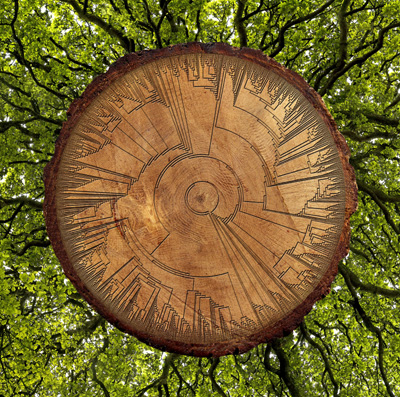 This work combines two representations of the Tree of Life: the oak tree as an ancient symbol of life in European mythology, here seen as a ring of English oak on a background of branches, and a current representation of the Phylogenetic Tree of Life from the Hillis and Bull Lab at the University of Texas. 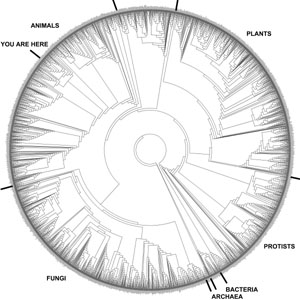 For Darwin, the ascent of all species through time was expressed as a metaphor he termed the Tree of Life. The modern development of this idea is called the Phylogenetic Tree. The diagram, with thanks to Professor Hillis for its use, is from an analysis of small sub-unit RNA sequences sampled from about 3,000 species. The number of species represented is about 0.18% of the 1.7 million species that have been formally described and named out of an estimated nine million. Understanding more about the biodiversity of our environment might just help us to appreciate and preserve our fragile planet earth. More information can be found at the University of Texas wesite. Exhibitions "Tree of Life - Homage to Darwin" was selected for the 12th International Digital Print Exhibition at the New York Hall of Science, organised by Art & Science Collaborations, Inc (ASCI) (3 October 2010 - 31 January 2011) and the Science Photographer of the Year at the Science Museum, London (October 2019 - January 2020). Further uses This image appeared as an illustration in the 2009 Larousse Encyclopedia yearbook; on the cover of a report for the Paris Summit on Climate Change in 2016; in a report for Stamford University and How Zoologists Organise Things, a book by Dr David Bainbridge published in 2020.
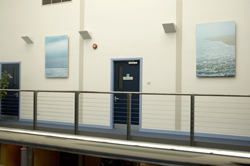
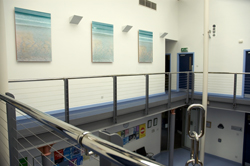
Work in Healthcare settingsCarol has been commissioned to make work for a variety of healthcare settings such as for the RD&E Hospital, Exeter; Arts and Health South West; the Leatside Surgery Totnes; and private practices. FIVE LARGE SEASCAPES AT THE LEATSIDE SURGERY, TOTNES
Puppetcraft Theatre CompanyProduction of work for sets for "Tristan and Isolde".
The Wrigley Company Ltd., PlymouthA set of photographs for the board room.
ABode (formerly Royal Clarence) Hotel, ExeterA set of photographs for the 2005 refurbishment.
|
 . . . . .